
Animals
Gelada in the Simien Mountains
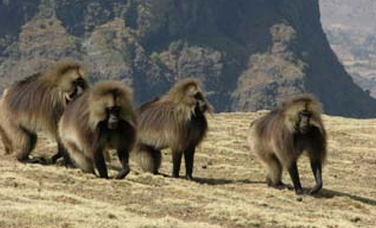
Gelada can be seen from Simien Lodge at the far western end of the national park and all the way up to Bwahit Mountain in the east. There are currently about 2700 monkeys in the Simiens. This number has remained fairly static since the first census was conducted in the mid 1970's. Although predators have declined, increased farming in the park means the gelada no longer have access to the same grasslands and woodlands as before.
Gelada live in family groups made up of a dominant male and up to 8 females with their respective young. They come together in larger bands, and during the dry season, these bands can be as many as 800 animals. By sunset each evening, most of the gelada have retreated over the escarpment, where they remain all night, protected from the predators.
Never rush at a gelada or look them in the eye. This is considered a threat. Sit in their migration path to get some incredible pictures.
Video of Gelada near the lodge
Leopard can also be found in the Simienss
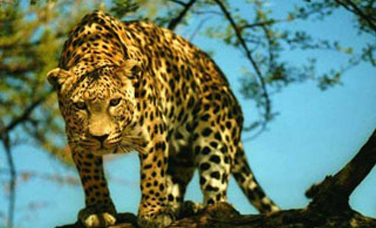
There are a few leopard in the Simiens but they are very rare. They live in the wooded valley areas of the north escarpment and sometimes venture onto the plateau to hunt although they prefer the cover of the trees. The best place to find leopard is around Sankabur although generally thir activity is nocturnal. There has never been any known attack on humans and it is quite save to walk in the Simiens.
Hyenas
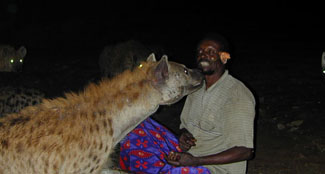
The picture shows the famous Hyena man of Harrar, but hyena are found in the Simiens too. Their number are now depleted by locals who consider them a pest. Likewise the jackal numbers are not as large as they used to be but common jackal can be viewed quite easily, especially at night.
Ethiopian wolf or Red Fox
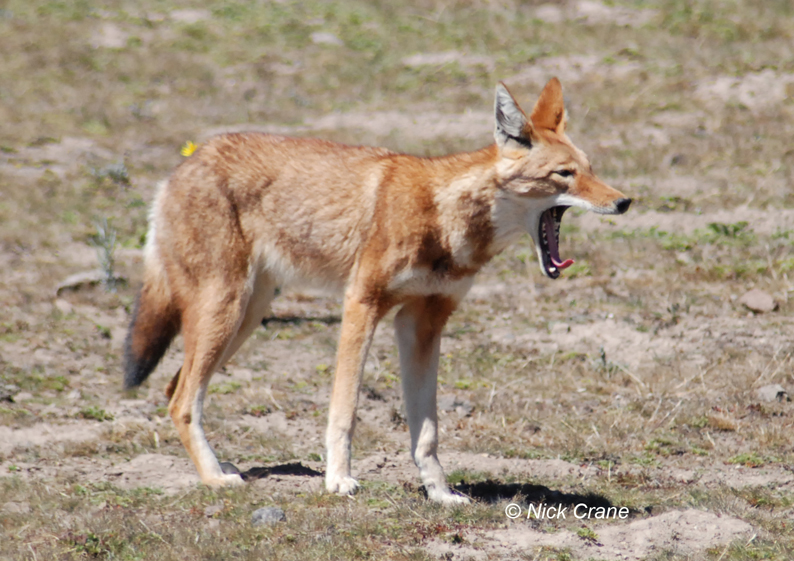
The number of wolves in the park is officially 77, but it could be lower. They are highly susceptible to rabies transmitted by domestic dogs, so, strictly speaking, dogs are not allowed in the park, although this rule is unfortunately often flouted. So, consequently, the endemic creature is now in great danger of extinction. Simien Wolves are descendants of the European wolf, which became stranded in the mountainous regions of Ethiopia as the last ice age retreated. Some wolves have been seen as far west as Simien Lodge and as far east as Ras Daschen. But the best viewing area is before Bwahit. However, on the east side of Bwahit, there is little control over poaching, so it is feared that the estimate of 77 wolves may be outdated.
For more information http://www.ethiopianwolf.org is the website of the Ethiopian Wolf Conservation Programme
Walia Ibex
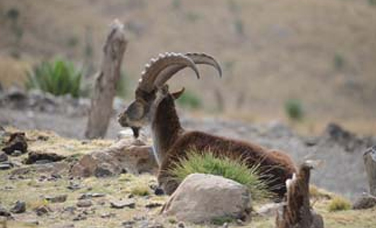
Walia numbers are increasing. They were once a threatened species but protection and reduction in predators has meant that their numbers are now on the up. They are easily recognised by their long curved serated horns and it is possible now to get within 100 meters of these beautiful animals. Chennuk is the best place to see them.
The Escarpment Edge
The second area recommended for a profitable hour or two is the escarpment edge itself. Try anywhere north of the Lodge where there is an uninterrupted view of the spectacular scenery. Find a comfortable rock where the view meets this description and watch for birds of prey above and below you. Bands of Gelada Baboons may view you with amusement rather than the other way round. Apart from birds of prey, other species to watch out for are White-collared Pigeon, White-winged Cliffchat, Abyssinian Catbird (which has a loud and beautiful song although usually delivered out of sight from thick cover of roses or other broadleaves) and pairs of White-backed Black Tit, all four being endemic species. Parties of Erckel’s Francolin may also be disturbed at the escarpment. Pay special attention if the gelada start sending out alarm signals, as, if you are lucky, a Simien Wolf may be wandering by.
Birds
The birdlife found near to Simien Lodge
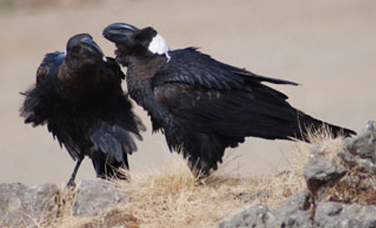
Over eighty species of bird have been recorded in the immediate area of Simien Lodge, but this total will undoubtedly continue to grow as more ornithologists and wildlife enthusiasts come to visit the Simien Mountains National Park and UNESCO World Heritage Site. This checklist can be expected to surpass the 100 mark in the very near future and may even double in due course. Migration periods in spring are mostly in March and April, and in autumn, from September to December, are when most new records are likely to occur. Please add your records to the checklist below, together with the date, or tell staff at the Lodge or your guide of any interesting sightings you may happen to make.
Of at least 30 endemic species of birds present in Ethiopia, no fewer than 12 can be seen on foot within a kilometre of the Lodge. An endemic species is one found nowhere else in the world. These are marked with an asterisk in the checklist. A further ten of these Ethiopian endemic species occur elsewhere in the National Park, at lower or higher altitudes. Some thirteen of the thirty species listed are also visible in Eritrea. Up to a further nine species may subsequently be recognised - described as new to science – from within Ethiopia; two of these, namely Ethiopian Cisticola and Erlanger’s Lark (marked with +), occur respectively at and near Simien Lodge. A feather from an Abyssinian Long-eared Owl, another probable endemic species, was found near the Lodge but, frustratingly, the bird could not be located. Shelterbelts of eucalyptus or lichen-festooned tree heaths would be likely places to look for a roosting individual.
A self-guided nature trail just 600 metres long (1200 metres return) is a recommended walk for visiting naturalists. This is down the valley to the south-west below the Lodge. Follow the stream-side down until you reach the villagers’ fields marked by a hedge of tall Eucalypts. This is just 600 m below the Lodge. Five hundred metres downhill is a small fenced grazing exclosure – compare the vegetation inside and outside this plot, and you will understand the impact of livestock grazing in the park. Weave your way back uphill through the Tree Heaths and Tree St. John’s Wort, and admire the endemic Abyssinian Roses. Typical birds you can expect to find along the way are Wattled Ibis, Brown-rumped and Streaky Serins, Dusky Turtle Doves and Chiffchaff (winter only). You may also find White-backed Black Tit, Brown Woodland Warbler and Abyssinian Slaty Flycatcher, or be lucky enough to locate the pair of unobtrusive Abyssinian Woodpeckers that glean food from lichens in the tree heaths here. Almost certainly, you will hear cinnamon bracken warbler, although this skulking species is often difficult, if not impossible, to see. Try waiting patiently by the thick bushes around the spring below the tacos. Speckled Doves, Fiscal Shrike, both serins and Abyssinian Cisticola will keep you company here.
Tawny Eagles
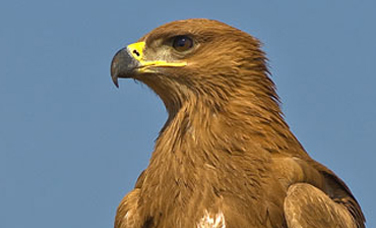
Don’t forget to watch overhead for birds of prey – with 18 species recorded to date, including several vulture and tawny eagle species, the sky is rarely empty for long, if at all. Fan-tailed Ravens cavort and tumble entertainingly whilst that remarkable Ethiopian speciality, Thick-billed Raven, prefers to loaf near the Lodge and scavenge noisily and boldly for kitchen scraps. Lammergeier is a bird that is easily seen at the Lodge, which is quite possibly the best place in the world to get point-blank views of this dramatic and much sought-after ‘Bonebreaker’.
Lammergayer
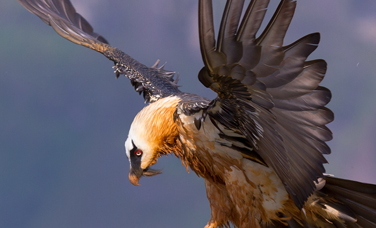
Photo: The Lammergayer is often confused with the eagle family but it is in fact a vulture.
Ankober Serin - a special Ethiopian bird
possible to see the Ankober Serin. This endemic species, which has a predilection for living on the rock face at the top of the often foggy escarpment, was, perhaps hardly surprisingly, only newly described to science following its discovery in 1979. This was near the village of Ankober in southern Ethiopia. Since that time, it has been found in at least three other localities, including very recently (from 1997) in Simien itself. The site near Simien Lodge is one such new site, but one needs to go to the precise spot to sit, watch, and wait for birds to arrive. The site is just 960m from the Lodge (as the raven flies) at the escarpment edge, which you come to at the top end of the open rose-filled valley to the east. The GPS coordinates of a safe lookout point are 13.12.35N 37.59.17E. The site can be recognised as a rather bare and crumbly basalt face below and across a relatively narrow cleft from the observation point. Ruppell’s Chat also occurs here (as well as by the river and falls a few kilometres outside the park entrance). Menelik’s Bushbuck has been seen coming to drink from pools near the roadside before the zigzag climb back up to the Lodge.
Contact Details
Ethiopian Address
Nigist Towers, 2nd floor, Kazanchis Addis Ababa, Ethiopia
Addis Office: +251 11 5524758
Lodge: +251 582 310741
European Address
Herentale 58, 17249 Platja d’Aro Spain
Tel: +33 610209635
