
Simien Lodge Location
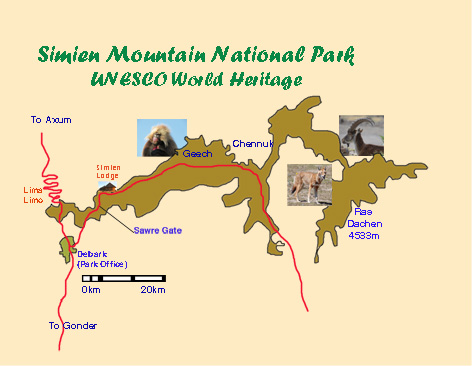

The lodge is located at the beginning of the escarpment, about 22km from Debark, the ' frontier town' of the Simien Mountain National Park.
Entrance tickets to the park are purchased at the park office in Debark, not at the park gate, which is about 16km from Debark.
TThe Lodge is another 6km past this gate, where the scenery really opens out. The escarpment starts at Simien Lodge, and before that, the drive from Debark town to the escarpment is largely farmland.
Note that the park is open from 6 am to 6 pm. Sometimes it is possible to get an extension to these times, but not always. So it is important to arrive before nightfall. Park staff sometimes refuse entry to those who arrive after dark, even if they have a reservation at the lodge. Payments will not be refunded under these circumstances.
Temperatures in the Simien Mountains
Temperatures in the Simiens vary tremendously between night and day and with altitude. The higher you are in the Simien Mountains, the colder it tends to be. During the day, it can be quite hot with a very powerful sun, but at night, as soon as the sun dips behind the mountains, the temperature drops dramatically and can fall below freezing at Gich and above. Hypothermia is a real possibility for trekkers who are not properly equipped.
Between October and May, the likelihood of rain is very slim — this is the Simien Mountains' dry season — but even during these months, it is worth bringing a waterproof jacket, because when it does rain, it pours. December and January are the coldest months, with the clearest night skies. The real rainy season is July and August, though even then it does not rain all the time.
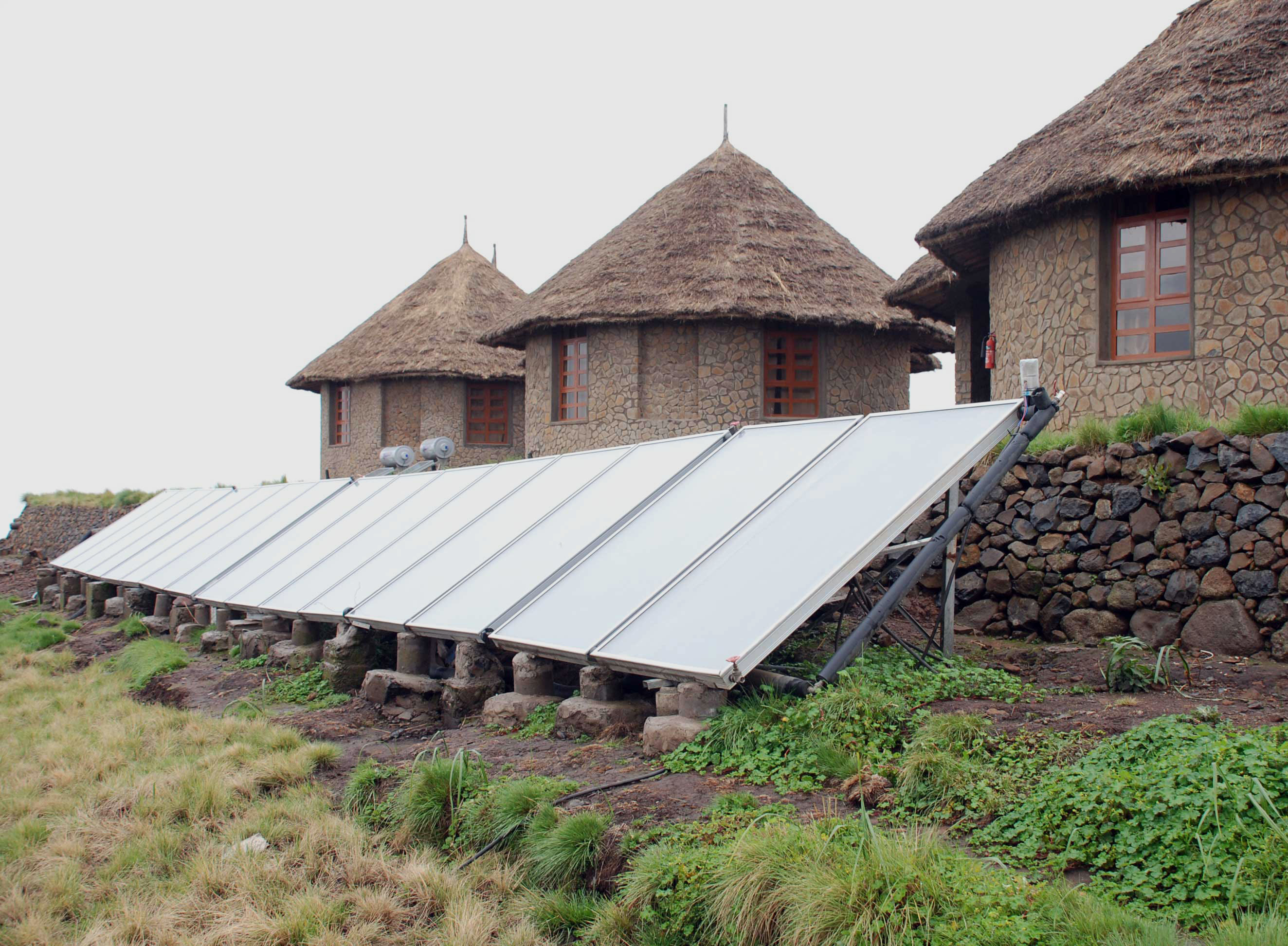
At the lodge, we have underfloor heating powered by solar panels. Hot water is pumped beneath the lodge floor during the day, raising the temperature by a few degrees. This is not a full central heating system and does not function during the rainy season. The Simiens are cold at night, so always bring warm clothing.

Simien Mountain National Park entrance fees
Note that these fees are charged in Debarak at the park office and are not fixed by Simien Lodge.
| Type of Visitor | Age / Category | ETB |
|---|---|---|
| Ethiopian | 12 years and above | 20 |
| Less than 12 years | 10 | |
| Student | 10 | |
| Foreign Resident Tourist | 12 years and above | 50 |
| Less than 12 years | 10 | |
| Foreign Tourist | 12 years and above | 90 |
| Less than 12 years | 10 |
Vehicle Fee
| Vehicle Seat Number | Ethiopian (ETB) | Foreign Resident Tourist (ETB) | Foreign Tourist (ETB) |
|---|---|---|---|
| Up to 12 seats | 10 | 15 | 20 |
| Greater than 12 seats | 15 | 30 | 40 |
Scouts and guides in Simien Park
The park authority has two distinct groups : Scouts and Guides.
Scouts are local men. Guides are educated people with knowledge of flora and fauna who speak English.
At present, it is park policy that a scout must go with the group into the park. The reason is as much to make local employment as for your safety, because it is difficult to get lost in the Simiens and the trek is very secure. Historically, it was not essential to take a guide, though your trip will be more informative if you do, and park officials generally ask you to take one. These days it is customary to take a guide and a scout, and they will expect to travel to the lodge in your vehicle.
Guide and scout prices may include the departure day, which confuses some people. Example: a visitor arrives on Monday morning and plans to leave the lodge on Wednesday morning. In this case, three full days will be charged. If you want the guide and scout to remain with you until Wednesday morning, insist on this when purchasing the ticket. Otherwise, some guides and scouts consider their work finished on Tuesday evening and will return home. This needs to be clarified at the time of ticket purchase.
There is no danger from wild animals in the park. The carrying of guns by the scouts is a throwback to the early days, when they looked to other African parks for inspiration. Consequently, Scouts do carry guns (Kalashnikovs), which may disturb some tourists. Professionals in the tourist industry work hard to dispel the myth of a land of war and famine, so this is a contradiction. If you don't like the gun, then just ask the scout to keep a discreet distance. However, these guys are very friendly and can provide useful information through an interpreter, as their English is limited.
It is always best just to book at the park office in Debark. Never be duped by offers of good equipment either in Gonder or elsewhere. Only sign contracts at the park office in Debarak.
We can provide scouts at the lodge, but not guides who are hired when you pay the park entrance fee in Debarak. There is a rota, and it is the responsibility of the guides’ association. Your guide & scout will be engaged in accordance with the rota system.
There are a couple of lady guides (photo) who are very popular with tourists.
Transport to and from the Simien Mountains
For all transport deep into the park, our transport can be rented through our agency www.eth-adv.com
When it rains, it is best to have a four-wheel-drive car, although the road is passable for two-wheel-drive vehicles in the dry season. Note that Coaster buses now struggle year-round. Driving between sunset and sunrise is not allowed in the park. Occasionally, we can organise a car for you in Gondar and a driver who will stay with you while in the Simiens. This is a good solution since you may want to trek deep into the Simiens and have the car bring you back along the vehicle track, which could save the walk back along much the same route (the Simiens are a long escarpment).
Driving
Please drive slowly in the park. The tour buses drive much too fast at the moment. They are often on a tight schedule, and the lack of good accommodation up to now has led them to rush to get out of the park before sunset. If you arrive by car, tell your driver to drive slowly along the escarpment. Fast driving only makes the animals flee, and this spoils things for everyone. Don't be afraid to comment to your guide. Don't let your driver rush your trip; he has seen it all before, and his main interest is getting back home as soon as possible.
Animals
The animals in the park are not dangerous. There are leopards and hyenas but you will be lucky to see them, and they will avoid you. If you are walking, they will see and hear you ten minutes before you see them. There are hamadryas baboons in the lowland area but don't go near them. They are aggressive if cornered. You should be able to see ibex, klipspringer, jackals and foxes. You can walk amongst a pack of jackals at night. They are not dangerous. There are no snakes; it is too cold for reptiles.
The gelada monkey (they are not baboons which is a different genus) can often be seen right outside your door in the morning. Their safe distance is 10 meters, the distance they use to flee from predators. Please do not feed the gelada. Gelada are highly intelligent and will become a nuisance to future tourists.
How to take great photos: Spread out when approaching gelada. Make some gentle noises so they know where you are. Don't look them in the eye, which is a sign of attack for a gelada, especially the males. Approach sideways. Don't rush at them in groups. You should be able to get within 2 meters of them if you go about it the right way and you will get some great pictures. Most nights we do a slide show in the lodge with information about the Gelada. It is very scientific and informative and adds to the enjoyment of viewing the animals.
There are often research projects going on in the Simiens with teams from the University of Michigan. If you see them, don't rush up to say hello. They have probably been there since 6 am and are waiting to get the right picture or an audio recording. You could spoil a whole morning's work. If you are in a car, ask the driver to turn the engine off.
Altitude sickness and sunstroke
Both are very real problems if you do not take precautions. The lodge is at 3300 meters, the highest in Africa. It is best to acclimatise for several days in Ethiopia above 2000 meters before coming to the Simiens. Altitude sickness can make you feel terrible and spoil your stay. The only remedy is to descend to Debark and sleep. Drink plenty of water before you come up to the lodge, and don't get dehydrated in the mountains. However, few people get altitude sickness. Only those people who have come straight from sea level are at risk. Sunstroke is more of a problem. Be sure to bring a hat.
Nuisances
Rats are common in the Simiens and are the natural prey of jackals and foxes. They are not suburban sewer rats.
Buying food in the Simien park
There is no foreign food available in Debark or the Simiens apart from at the lodge. In Debark, the food is limited. Bread is available from a bakery. Otherwise, it is generally Ethiopian enjera and wot.
Credit cards and money
We will accept US dollars, UK Pounds, Euros and Ethiopian Birr. Simien Lodge accepts credit card payments at our Addis office but not at the lodge (a modem connection to banks is required). There are now many ATMs in the main towns, including Debark, the frontier town of the Simiens. Bring cash with you for payment for souvenirs and tips. Ethiopia is generally very safe, and robbery is very uncommon. However, the largest denomination is the 100 birr note, which is worth about $2. So this might mean that you are carrying large bundles of notes. Credit cards are starting to be accepted.
Maps
There is currently only one map available, printed originally by the University of Berne in 1977. Most of the guides have photocopies. Occasionally, these maps are available at the park office for $30.
Study tours & evening talks
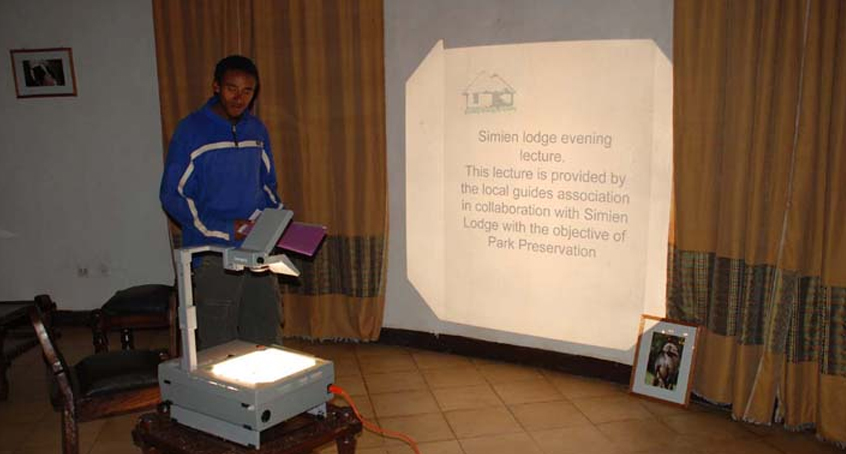
Most nights we have something going on in the lodge, varying from a film to an evening lecture.
Camping in the Simiens
Trekking and camping provide several possibilities. If you are staying in the lodge at the beginning or the end of your trek, then you can leave unwanted baggage with us so you can walk ' lightweight' for walking. You can hire donkeys and mule drivers. You can hire a horse to ride, although Simien horses are smallish beasts, and you might feel that you are abusing the unshod horse after a short while. The Simien people treat animals badly as a rule, and tourists can help through education. At the lodge, we have good new tents and sleeping bags. If you hire in Gondar or Debark, be careful, as most tents leak and the sleeping bags are thin. Our sleeping bags are rated to -5 and are properly cleaned after each trek. Please advise us in advance and list the number of tents, sleeping bags, mules, guides, etc that you require.
There is a ' refuge' at Sankabur but it is not a lodge in the sense of Simien Lodge, and we prefer that our guests not use it except in the rainy season. The same applies to so-called ' Community Lodges'. They are OK if you don't mind roughing it, but they are not real lodges. Don't expect a shower or a proper toilet.
Note: Clients staying at Simien Lodge may leave unwanted luggage at our store.
Activities Available at Simien Lodge
From Simien Lodge you can hire:
- Tents (two person) Quetcha automatic type
- (Winter) sleeping bags rated to -5deg
- Mattresses plates, spoons, knives, forks and cups
(and the stove can be rented from the Cook or Debark Park Office)
Beware of hiring used equipment in from places which do not specialise. The equipment is often poor quality and you could end up either very wet or very cold.
Different types of trekking available around the Lodge are:
Half-Day Walks
It is possible to take either challenging or not too challenging routes from the lodge which last just half a day and either return to the lodge by foot or to walk further afield and get picked up by car in order to come back to the lodge for lunch (and if you are on a tight schedule to even return to Gonder that afternoon).
Day Walks
The walk to Saddick Amba monastery takes about two hours to go down and three hours to climb back up the escarpment. It is one of the most beautiful treks in the Simiens.
Day Walks
You can order a packed lunch from the kitchen and stock up on water and head out for the day. You can stay on the relatively flatter paths of go off the beaten track and try some of the more challenging hillier walks to nearby view points, waterfalls and villages and then walk back and get picked up by car.
If you want a challenge then you can walk down the sides of the escarpment to the plateau to visit the Adarmaz monastery. The walk involves some narrow paths and stell ladders down vertical rocks (although the quality of these may vary!)
Nature Walks
Every walk in the Simiens is a nature walk. But if you're keen on photography, beautiful landscapes and scenery, flora and fauna or wild animals, you don't need to walk far from the lodge to be immersed in amazing examples of all of these. (In fact, you can sit on your sun-porch and watch it come to you.) But if you aren’t that patient, tailored walks can be designed to incorporate any of these aspects. You can find one of the nearby Gelada Paths and sit just metres away from these amazing animals or walk to spectacular viewpoints.
Extended treks in the Simiens
You can, of course, extend your trekking experience to camp out and walk deeper into the park over a few days. Possible routes include:
3 days leisurely trekking from Buit Ras (Simien Lodge) to Sankaber (5 Hours), Sankaber to Gich (6 Hours), and Gich to Chenek (7 hours) and get picked up by car.
This can be made into a shorter or longer trip, as you can get picked up at the end of any day or could walk yet further into the park or make it into a 6-day trek if you walk back as well!
Variations include staying at Gich Camp for a few nights and doing some day walks around the Gich escarpments to avoid having to increase altitude any further.
2 more days of physical walking: from Buyat Ras to Gich (7 Hours) and Gich to Chenek (5 hours), and you can come back by car or walk.
Ras Daschen
You also have the opportunity to climb the highest mountain in Ethiopia - Ras Dashen. Although this could be done in 6 days from the lodge, we would advise taking longer over it unless you are properly acclimatised to these altitudes. Alternatively, you can travel by car to Chunnuk camp or Bwahit and start trekking from there.
From Bwahit, it is a three-day trek.
From Bwahit, you descend to the Mesheba River, a 4-hour descent through the village of Chiroleba. After the river at 2700m, you climb to the camp, which takes about 2 hours. The trek to the summit normally starts about 4 am the next day, since the summit is often shrouded in clouds that come later in the day. There is a long traverse through giant lobelia woods. The final 100 meters to the summit require some rock climbing skills. There are a couple of parts which are steep. The same morning, the return to the camp is quite simple, but the total walking time on this day is about 10/11 hours. The return to Bwahit the next day is perhaps the most tiring part of the three days. There is no radio communication, no search-and-rescue, no medical facilities on the far side of Bwahit.
Everything taken care of:
As a result of the altitude, the more popular way of trekking requires you to hire a scout, guide, cook, mules and mulers. Extra horses are available to take if you would like a backup in case it is harder in places than you had imagined. This allows you to concentrate on the good views and the enjoyable trekking, with tents, food and navigation is taken care of.
Challenging trekking with your home on your back!
If you are feeling fit, it is also possible to hire only a scout (who will know the routes of the more popular treks but may struggle more off the beaten track!). If you have a large enough rucksack, you can carry everything with you, including food, water, etc.
To make this a viable option, you will need to bring all your trekking equipment from home, as the equipment on hire here is not lightweight; it is designed for mules!
(Limited) Food can be brought from Debark, but it is more reliably brought from Gondar or Axum. Camping gas cylinders are available in Addis, or you can bring a multi-fuel or petrol stove with you instead, and it is best to buy fuel in Gonder, although limited supplies of fuel are available in Debark.
Notes on Horse Trekking
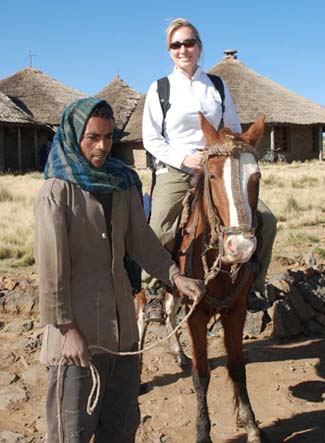
The Horses in Ethiopia are not the same size as those in Europe and tend to be a little smaller, so although they are good as a backup, they are generally unable to carry heavy loads up or down the steeper hills. The equipment used here is somewhat rudimentary and, as such, is not as kind to the horses. The horses are not treated to such a good standard as the horses in Europe.
Simien Lodge supports international efforts regarding global warming and assisted with the planting of 7000 trees last rainy season.
Contact Details
Ethiopian Address
Nigist Towers, 2nd floor, Kazanchis Addis Ababa, Ethiopia
Addis Office: +251 11 5524758
Lodge: +251 582 310741
European Address
Herentale 58, 17249 Platja d’Aro Spain
Tel: +33 610209635
